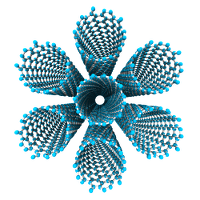
sknano.structures.SWNT
-
class
sknano.structures.SWNT(*Ch, *, nz=None, basis=['C', 'C'], bond=1.42, gutter=None, Lz=None, fix_Lz=False, wrap_coords=False, **kwargs)[source][source]¶ SWNT structure class.
Parameters: nz :
int, optionalNumber of repeat unit cells in the \(z\) direction, along the length of the nanotube.
basis : {
list}, optionalList of
strs of element symbols or atomic number of the two atom basis (default: [‘C’, ‘C’])New in version 0.3.10.
element1, element2 : {str, int}, optional
Element symbol or atomic number of basis
Atom1 and 2Deprecated since version 0.3.10: Use
basisinsteadbond : float, optional
\(\mathrm{a}_{\mathrm{CC}} =\) distance between nearest neighbor atoms. Must be in units of Angstroms.
Lz : float, optional
Length of nanotube in units of nanometers. Overrides the
nzvalue.New in version 0.2.5.
tube_length : float, optional
fix_Lz : bool, optional
Generate the nanotube with length as close to the specified \(L_z\) as possible. If True, then non integer \(n_z\) cells are permitted.
New in version 0.2.6.
verbose : bool, optional
if True, show verbose output
Examples
>>> from sknano.structures import SWNT
Create a SWNT with \(\mathbf{C}_{h} = (10, 10)\) chirality.
>>> swnt = SWNT((10, 10), verbose=True)
>>> print(swnt)
SWNT((10, 10), nz=1)
n: 10
m: 10
t₁: 1
t₂: -1
d: 10
dR: 30
N: 20
R: (1, 0)
θc: 30.00°
Ch: 42.60 Å
T: 2.46 Å
dt: 13.56 Å
rt: 6.78 Å
electronic_type: metallic
Change the chirality to \(\mathbf{C}_{h} = (20, 10)\).
>>> swnt.n = 20
>>> print(swnt)
SWNT((20, 10), nz=1)
n: 20
m: 10
t₁: 4
t₂: -5
d: 10
dR: 10
N: 140
R: (1, -1)
θc: 19.11°
Ch: 65.07 Å
T: 11.27 Å
dt: 20.71 Å
rt: 10.36 Å
electronic_type: semiconducting, type 2
Change the chirality to \(\mathbf{C}_{h} = (20, 0)\).
>>> swnt.m = 0
>>> print(swnt)
SWNT((20, 0), nz=1)
n: 20
m: 0
t₁: 1
t₂: -2
d: 20
dR: 20
N: 40
R: (1, -1)
θc: 0.00°
Ch: 49.19 Å
T: 4.26 Å
dt: 15.66 Å
rt: 7.83 Å
electronic_type: semiconducting, type 1
Attributes
ChSWNT circumference \(|\mathbf{C}_h|\) in Å Ch_vecSWNT chiral vector. LzSWNT length \(L_z = L_{\mathrm{tube}}\) in nanometers. M\(M = np - nq\) NNumber of graphene hexagons in nanotube unit cell. NatomsNumber of atoms in nanotube. Natoms_per_tubeNumber of atoms in nanotube \(N_{\mathrm{atoms/tube}}\). Natoms_per_unit_cellNumber of atoms in nanotube unit cell. NtubesNumber of nanotubes. RSymmetry vector \(\mathbf{R} = (p, q)\). TLength of nanotube unit cell \(|\mathbf{T}|\) in Å. TvecSWNTtranslation vector.atomsStructure StructureAtoms.basisNanoStructureBasebasis atoms.chiral_angleChiral angle \(\theta_c\) in degrees. chiral_typeSWNTchiral type.crystal_cellStructure CrystalCell.d\(d=\gcd{(n, m)}\) dR\(d_R=\gcd{(2n + m, 2m + n)}\) dtNanotube diameter \(d_t = \frac{|\mathbf{C}_h|}{\pi}\) in Å. electronic_typeSWNT electronic type. element1Basis element 1 element2Basis element 2 fix_LzfmtstrFormat string. latticeStructure Crystal3DLattice.linear_mass_densityLinear mass density of nanotube in g/nm. mChiral index \(m\). nChiral index \(n\). nzNumber of nanotube unit cells along the \(z\)-axis. rtNanotube radius \(r_t = \frac{|\mathbf{C}_h|}{2\pi}\) in Å. scaling_matrixCrystalCell.scaling_matrix.structurePointer to self. structure_dataAlias for BaseStructureMixin.structure.t1\(t_{1} = \frac{2m + n}{d_{R}}\) t2\(t_2 = -\frac{2n + m}{d_R}\) tube_lengthAlias for SWNT.Lztube_massSWNT mass in grams. unit_cellStructure UnitCell.unit_cell_massUnit cell mass in atomic mass units. unit_cell_symmetry_paramsTuple of SWNTunit cell symmetry parameters.vdw_distancevan der Waals distance. vdw_radiusvan der Waals radius Methods
clear()Clear list of BaseStructureMixin.atoms.generate_unit_cell()Generate the nanotube unit cell. make_supercell(scaling_matrix[, wrap_coords])Make supercell. read_data(*args, **kwargs)read_dump(*args, **kwargs)read_xyz(*args, **kwargs)rotate(**kwargs)Rotate crystal cell lattice, basis, and unit cell. todict()Return dictofSWNTattributes.transform_lattice(scaling_matrix[, ...])translate(t[, fix_anchor_points])Translate crystal cell basis. write_data(**kwargs)write_dump(**kwargs)write_xyz(**kwargs)